
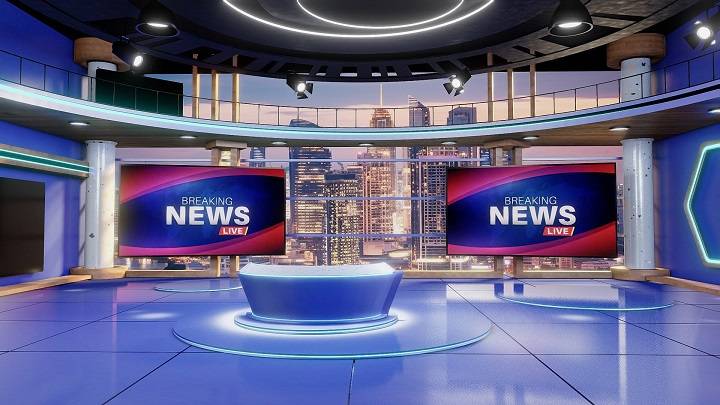
News Studio: The Making of Contemporary Broadcast Journalism
A news studio is more than a glittery backdrop, it’s the hub of live reporting. It’s where anchors break the biggest stories, correspondents report live by satellite, and the world gets its daily dose of confirmed news. Whether local television or international network, all programs begin here.
Here, we will take you through the working of news studios, why they are evolving so rapidly in 2025, and why they are gaining both cultural and technological significance.
4 Ingredients of a News Studio Today

Successful news studios always deliver four ingredients:
- Studio Floor & Set Design
- Production Control Rooms & Master Control Facilities
- Electronic News Gathering & Outside Broadcast Integration
- New Technologies: AR, Robotics & Virtual Production
Let’s take each of these apart and see how news progresses from concept to your screen—and how technology is changing the business.
Studio Floor & Set Design
The hub of a news studio is the studio floor, a custom-built space for live presentation. The studio floor typically holds:
- Anchor desks and set pieces
- Videowalls and augmented reality backdrops
- Professional video cameras, light rigs, and microphones
- Teleprompters and stage management systems
- Make-up rooms, green rooms, and audience holding areas
Major network studios today have video walls, video floors, and interactive AR graphics in creating immersive storytelling.
Why it Matters
Set design makes or breaks the visual identity of a broadcast. Dynamic graphics and flexible backdrops make it possible for sophisticated stories, from weather forecasts to political discussions, to be delivered with precision and punch.
Production Control Rooms & Master Control Facilities
Behind the cameras is a maze of technical nerve centers:
- The Production Control Room (PCR) manages camera switching, audio mixing, graphics, and live feeds.
- The Central Apparatus Room houses servers, routers, character generators, and vision mixers.
- The Master Control Room (MCR) is the gateway to broadcasting, managing signals, network feeds, and transmitter output.
All the rooms are linked with one another to deliver unbroken live programming, ranging from national bulletins to local news bulletins.
Electronic News Gathering (ENG) & Outside Broadcast
Modern news studios rely heavily on Electronic News Gathering (ENG) that entails a process where news is edited and broadcast live by recording it with portable video and audio equipment.
Examples include:
- A single reporter with a camera or phone
- Microwave or satellite-feeding news vans
- IP-based digital mobile news gathering hardware with live HD video streaming
Such systems allow the studios to record field events, accidents, rallies, emergencies, live, with signal relayed back to the control room.
New Technologies: AR, Robotics & Virtual Production
Physical construction is being blended with digital technology by studios nowadays:
- Augmented Reality (AR) studios offer interactive weather graphics and story graphics live
- Robotic camera systems offer cinematic pan, tilt, and zoom moves in local newsrooms at lower costs than the conventional setups
- LED virtual production levels enable rapid, scene-rich news production without the use of sets
The solutions help studios to rapidly change, create engaging images, and stay ahead of digital disruption.
Why News Studios Remain Relevant in the Social Media Age

News studios remain relevant in spite of the rise of social media:
- They’re journalism quality hubs, with expert reporting and editorial decision-making in one location
- Newscasts still dominate live sports and breaking broadcasts
- Studios are now able to produce multi-platform, sending content simultaneously to TV, web, social media, and mobile apps
- Even highly fragmented media audiences still require live, credible newscasts of studio-based news products.
What Motivates a Modern News Studio
Learn more about what it takes for a news studio to operate and thrive in 2025:
Cameras & Production Equipment
Feeds come from robotic PTZ, high-definition, and even 4K cameras designed for live coverage, streaming, and AI tracking.
Audio Infrastructure
Systems accommodate wireless audio control of multiple studios—essential for broadcasters broadcasting live shows concurrently.
Graphics & Virtual Sets
Cutting-edge technologies provide studios with capabilities for superimposing maps and data visualizations in real-time, enhancing storytelling.
Automation & IP Workflows
IP-based routing solutions provide remote commentary and excellent audio in international broadcasts.
Remote & Cloud Production
Studios are increasingly adopting remote production workflows and cloud platforms that enable teams to work together on continents, at lower costs and greater flexibility.
Leadership Examples: How Major Studios Are Shaping the Future
- High-end studios in the UK, Europe, and Asia deliver simultaneous TV and radio production in open-floor, multi-purpose design studios.
- Certain studios have equipped their studios with LED walls, AR graphics, 360-degree turn, and high-end visualization software-driven immersive sets.
Local stations in the United States are revolutionizing their newsrooms with LED video walls and AR data presentations, spurred on by scalable studio platforms for immersive local consumption.
A Glimpse at the Production Process: Assignment to On-Air
A news story takes the normal route:
- Assignment – Assignments are distributed in the newsroom by editors.
- Field Reporting – The reporter records with ENG or satellite feeds.
- Editing & Voiceover – Editors and producers construct packages in post rooms.
- Live or Taped Delivery – Anchors are directed by directors in the studio; audio, video, and graphics get mixed live.
- Transmission – Master control feeds TV, online, and mobile delivery systems.
Trends Shaping News Studios in 2025
Three massive trends transforming broadcast are:
- AI Integration: Newsrooms are utilizing AI for highlight clipping, automated graphics, and real-time multilingual voiceovers
- Scalable Studio Robotics: Robot arm and presetting make smaller stations able to produce cinematically-driven storytelling with fewer humans
- Virtual Studios and Cloud Production Hubs: Quick virtual environments reduce physical build-outs and boost flexibility
Advantages of Studio Modernization

- Enhanced Visual Appeal engages audiences
- Operational Efficiency reduces the number of manual camera and set designers
- Cross‑Platform Workflow supports publication on TV, online, mobile
- Flexibility allows broadcasters to easily switch over in the event of breaking news or live events
The Emergence of Pop-Up and Mobile Studios
There has been an ongoing epidemic of pop-up studios and mobile broadcast units in recent years, especially after global crises and rapid-breaking news cycles. They are temporary or mobile installations in disaster zones, election command posts, sports events, or even on the street for breaking news. Compact, efficient, and on-the-go, these mobile studios utilize satellite uplinks, bonded cellular transmission, and field equipment to replicate the functionality of an entire studio, anywhere in the world. They have become the norm for reporting breaking stories in the moment without being constrained by the confines of a fixed location.
Guidance of Audience Participation Tools
With a shift towards interactive journalism, news studios today are including live audience participation tools in their programming. They include live polls, social media-based viewer questions, and live responses through mobile apps and SMS. Anchors now engage viewers directly in reply during live programming, news turning into an interactive two-way discourse. All these innovations build viewers’ trust, retention, and enable stations to catch up with a time when younger viewers prefer interactivity to passive viewing.
Sustainability in Studio Design
Another trend that is surfacing in 2025 is the green movement in news production. Green studios are being constructed on green principles, LED lighting, solar power, biodegradable set materials, and energy-efficient broadcast equipment. The majority of the big networks have committed to reducing carbon emissions and rebuilding their bricks-and-mortar on those premises. Going green is now no longer a PR plus but a future cost-saving and operational benefit for broadcast companies to stay future-proof.
Who Should Remain Current with News Studio Developments?
Broadcast Engineers & Technologists
Discover IP workflows, robotic operation, and LED studio construction.
Station Executives & Producers
Learn how visual identity, graphics systems, and AR affect viewer engagement.
Content & Marketing Teams
Discover how visual storytelling techniques impact engagement on all platforms.
Students & Media Educators
Experience a tour of a high-tech newsroom, from camera operation to transmission.
Advertisers & Sponsors
Capitalise on the top-level production value that takes brand presentation to new heights in local television.
With this age of social media and streaming, news studios bring structure, credibility, and visual continuity. They’re where factual reporting and engaging visuals intersect, presented with integrity and panache.
With high-tech LED walls, robotic cameras, and real-time AI graphics, studios are evolving faster than ever before. But the basic mission remains the same: to report facts, educate society, and be prepared for whatever the news requires.
Even in a time of constant feeds and user-generated video, people still turn to trusted news studios, the centers where facts are verified, pictures are told, and stories are put into context.